Personal Product · Case Study
Getman
A local-first API client that hands API changes to frontend teams through Git
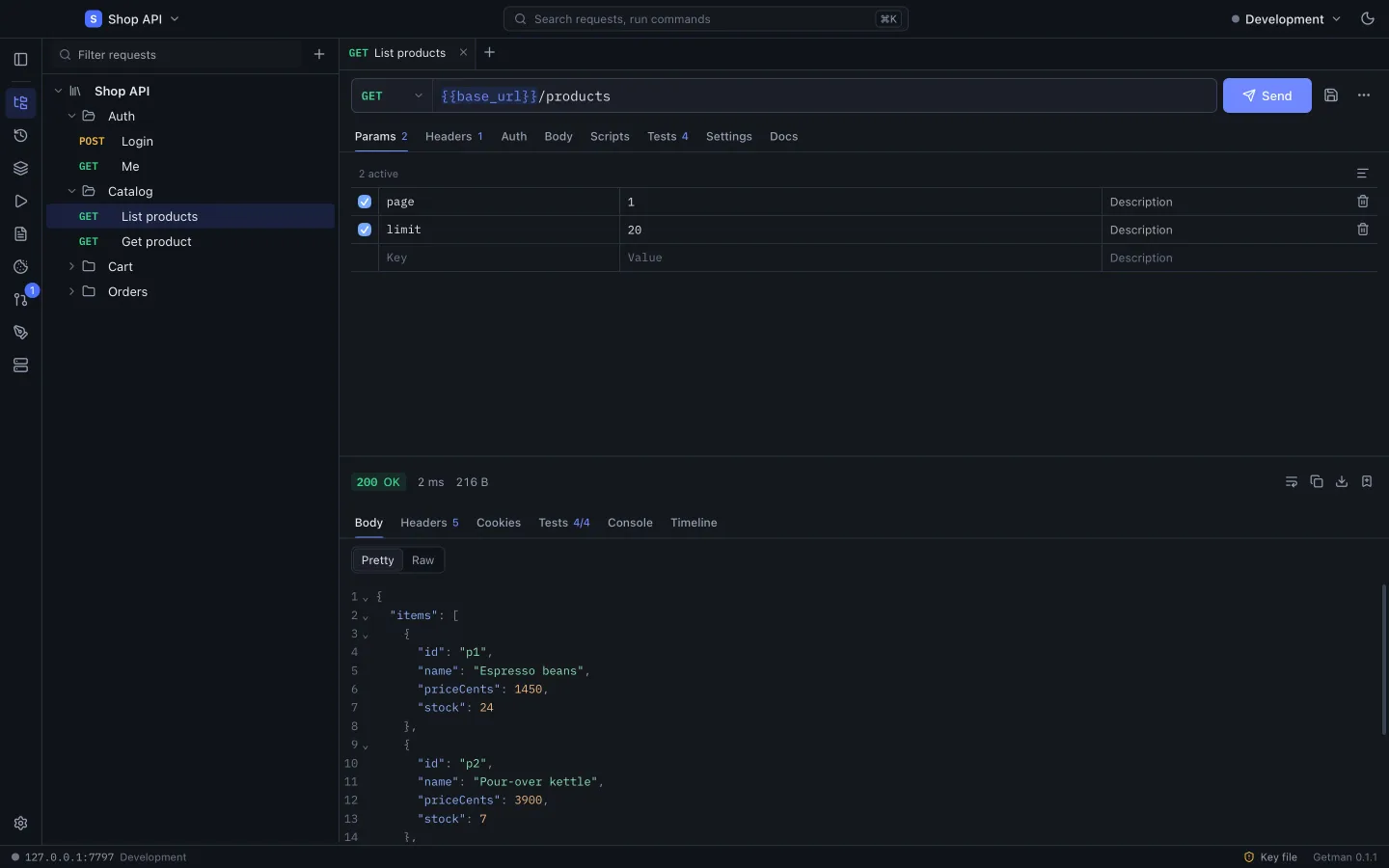
Getman is a desktop API client for macOS and Windows. You build and test requests on your machine, then send each API change to your frontend team and their coding agents through the Git repository you already use. I'm the sole author of the idea and the implementation. AI coding agents were tools in the build, not co-authors.
The problem
An API change usually reaches the frontend outside the code.
It arrives in a chat message, a doc, or a shared request collection. The person who tests a request and the person who depends on it rarely see the same evidence, and the contract is often out of date by the time someone reads it.
I wanted the tool that tests requests to keep its data on the developer's machine, and the change itself to travel with the code.
Product vision
Local-first, with Git as the only shared channel.
- Requests, responses, history and secrets stay on the developer's machine.
- A change to an API is a file in the repository, with its contract diff, examples and test evidence.
- Coding agents get the same contract and examples a human reviewer gets, inside limits the developer sets.
- No account, no sync service and no telemetry. Free to use.
Architecture
A Rust core for transport and storage, and one TypeScript core for product logic.
- Tauri 2 shell with a React 19 and TypeScript interface, and Zustand for state.
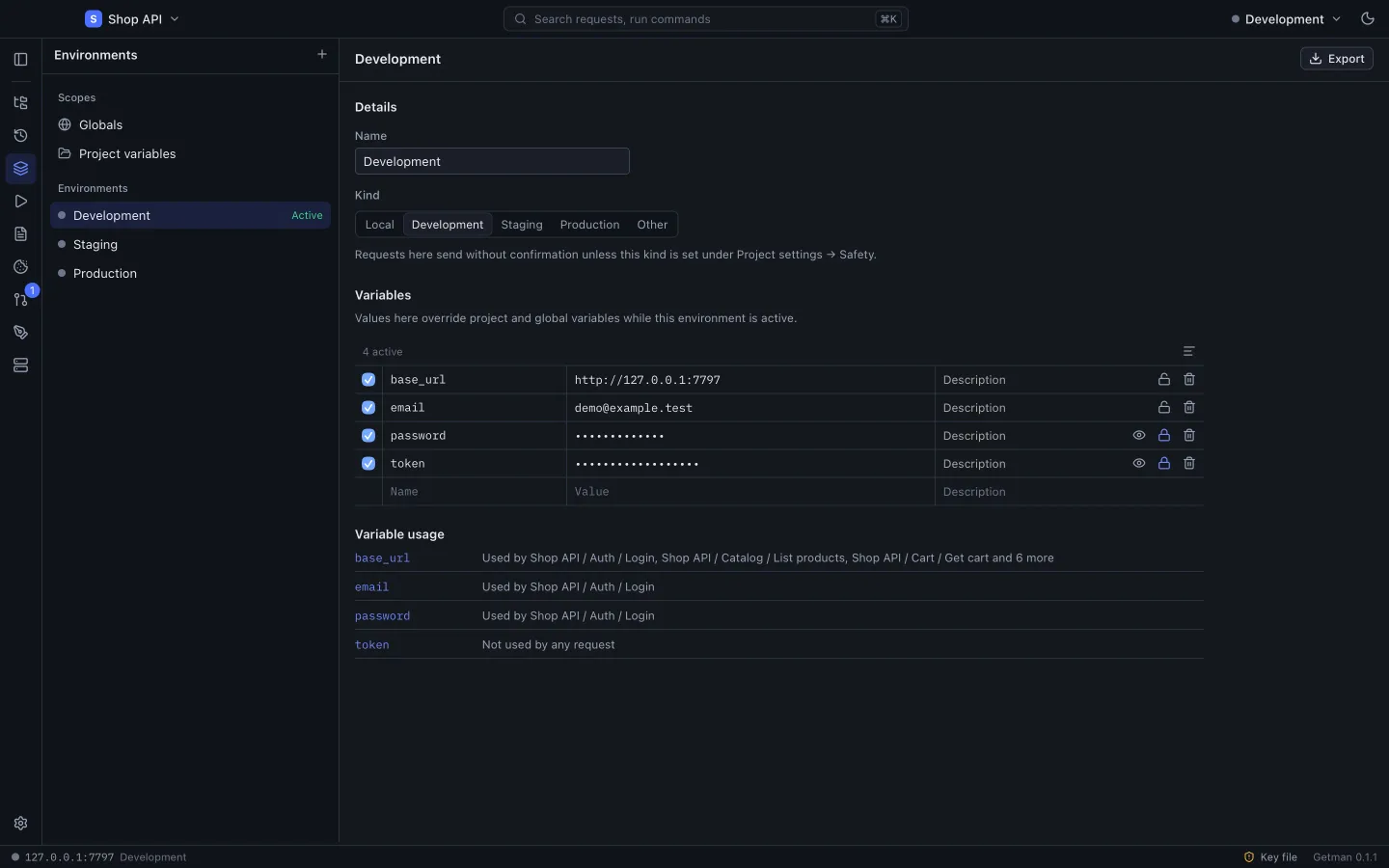
- Rust handles HTTP, WebSocket, Server-Sent Events, SQLite storage, secrets and file sync. Variables, auth, scripts, the request pipeline, the runner and the importers are pure TypeScript, unit-tested without a webview.
- Secrets are encrypted with AES-256-GCM in the local database. The master key lives in the OS keychain.
- Scripts run in a QuickJS sandbox compiled to WebAssembly, with a 32 MB memory limit and a 5 s default timeout.
- The getman CLI and the local MCP server run requests through the same engine the app uses.
- Projects sync to Git as plain YAML: one file per request, environments with secret values left blank, and change packages under changes/.
Git & MCP workflow
One API change, from backend to frontend, with no server in between.
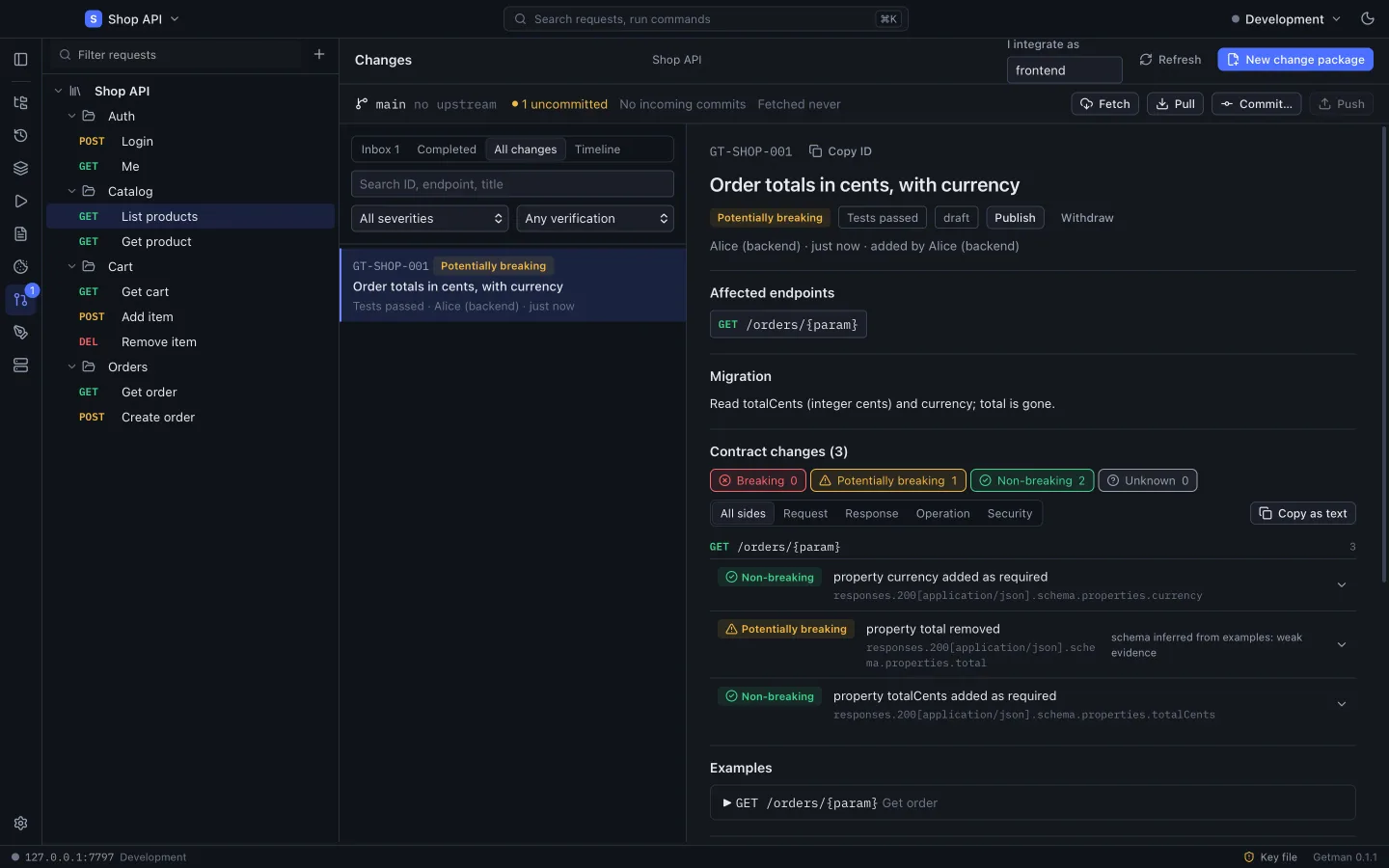
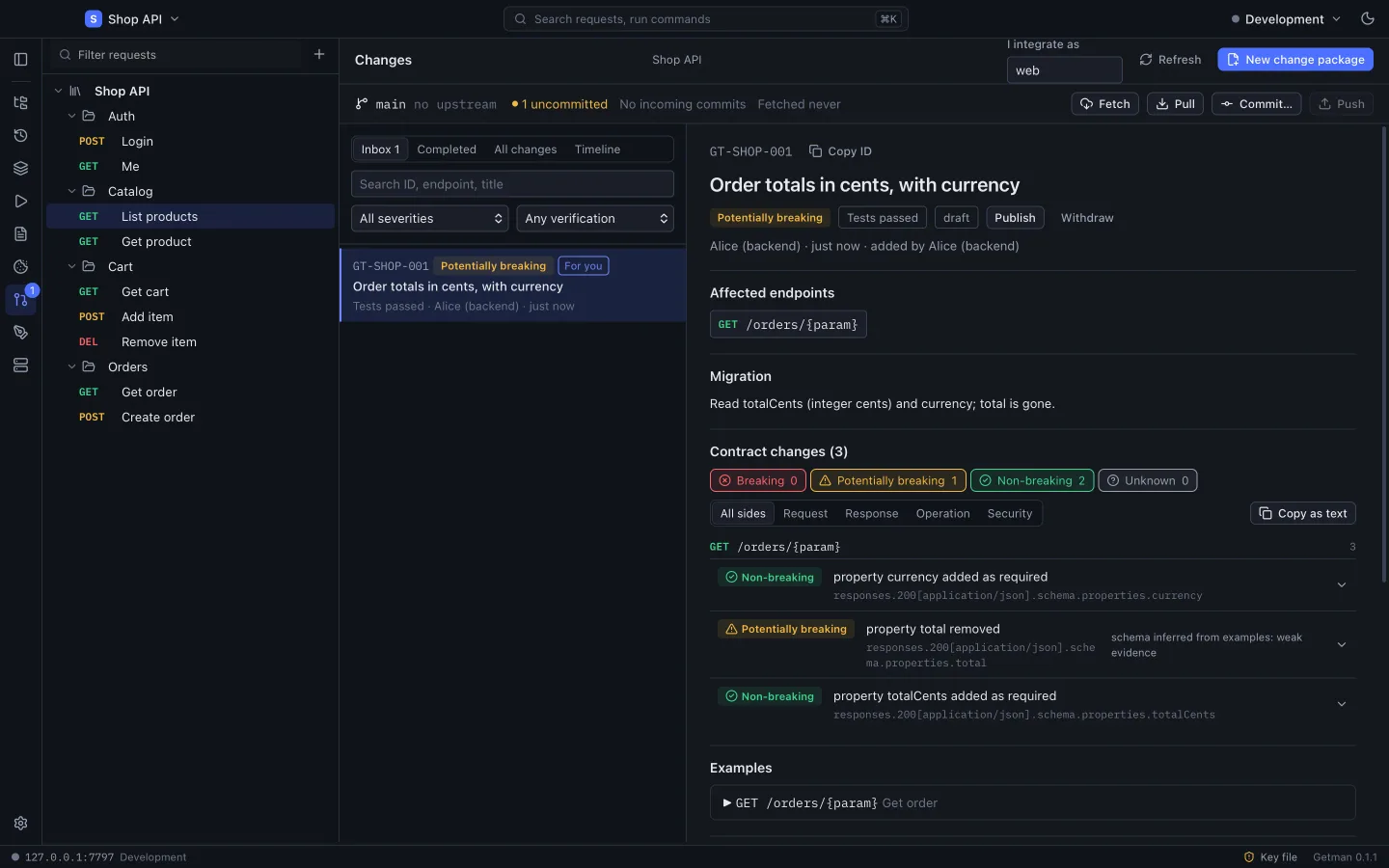
- A change package records the endpoint, the contract diff, examples, a migration note, commits and evidence.
- The contract diff rates each change as breaking, potentially breaking, non-breaking or unknown, separately for requests and responses.
- Evidence comes only from real runs. Verify now executes the affected requests, and seven labels run from Not tested to Integration verified.
- Change packages move through draft, published and withdrawn.
- Fetch shows incoming packages in the Integration Inbox before anyone pulls.
- Git stays explicit. Fetch, Pull (fast-forward only), Commit and Push use the developer's own Git and credentials.
- The local MCP server exposes 11 read tools and 4 write tools, limited to chosen folders.
- A coding agent's POST, PUT, PATCH or DELETE to a production environment needs approval for each request. --read-only removes every write tool.
Technical challenges
- Blank values never become literal text. A header, query, cookie or auth value that uses an undefined or empty variable is left out and logged, instead of sending {{name}} to the server.
- An error status is not a pass. The CLI used to report a 500 as passed when a request had no tests. Now a 4xx or 5xx fails unless an enabled status assertion pins that status.
- Secrets never reach Git. Secret values are blank in the YAML files, and each developer fills them in once into their own keychain. Agents read them from GETMAN_VAR_<KEY> in the shell that starts them.
- Team sync is merge-safe. Pull is fast-forward only and never merges, stashes or resets. Conflict markers are refused on load and on commit.
- Scripts cannot reach the network. gm.sendRequest throws, so requests are chained through variables instead.
- Agent writes to production are approved one by one. The approval form is part of the MCP client, not a server-wide switch, and I verified it in an interactive Claude Code session.
Testing & results
Numbers from the final run on 2026-10-10, for version 0.1.2.
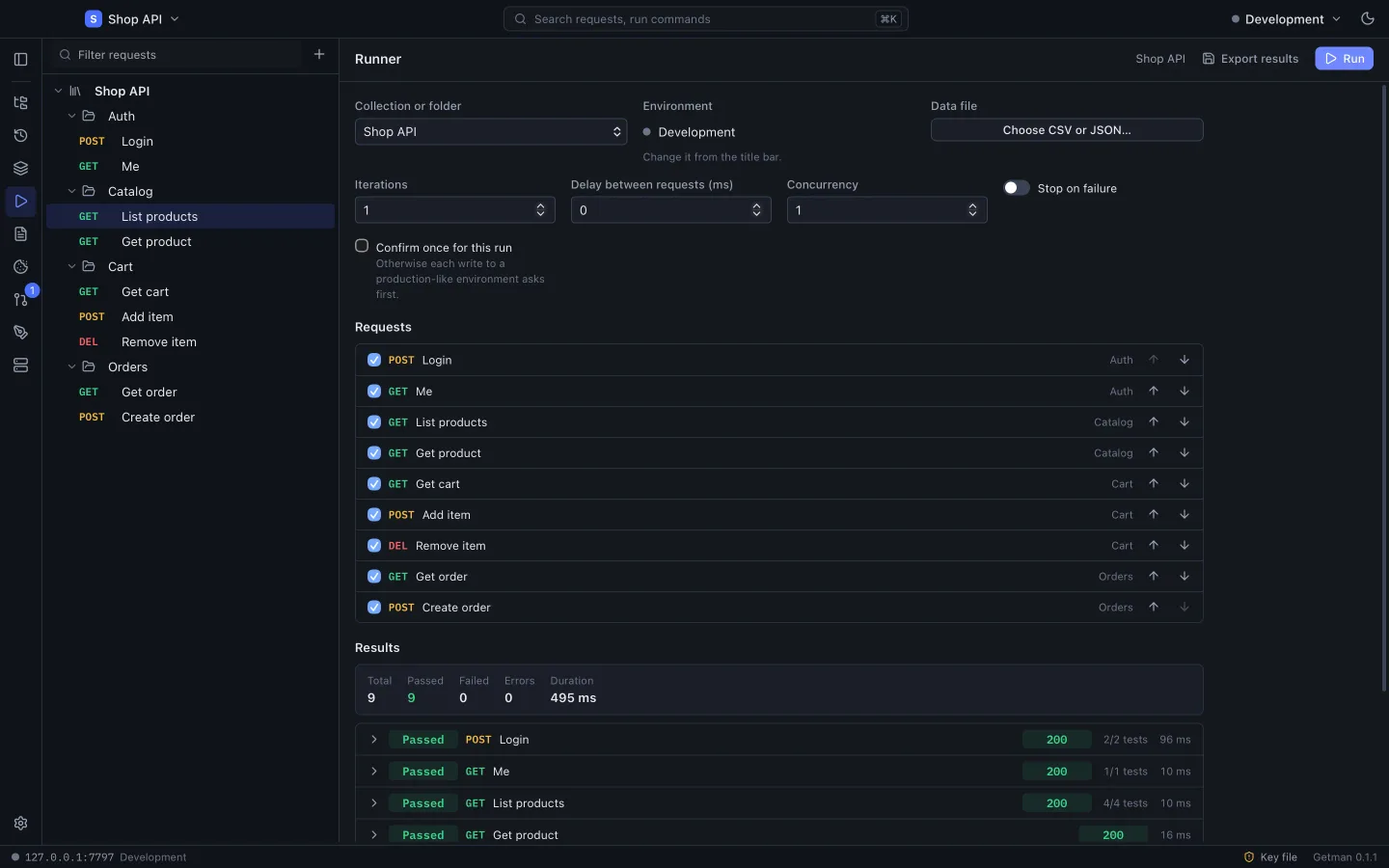
- 812 of 812 unit and CLI/MCP integration tests pass, across 57 files.
- 72 of 72 Rust tests pass.
- 64 Playwright end-to-end tests pass with 0 failures, and 3 opt-in checks are skipped.
- Every OpenAPI export of the 14 seed projects passes the official OpenAPI 3.1 JSON Schema, and every $ref resolves.
- Two intermittent E2E failures were traced to test races, not app bugs. Each fix comes with a regression test. One importer timeout is still unexplained.
- A macOS universal release build was verified locally: a 14.4 MiB app and an 8.3 MiB disk image.
- Not yet tested: Windows. CI builds the Windows installers, but nothing has been installed or run on a Windows machine. The macOS build is not yet signed.
Demo & downloads
The tutorial is a narrated walkthrough of about 11 minutes, with captions.
It covers installing Getman, everyday API work, the Git files, connecting Claude Code, and one API change from backend to frontend.